

class: center, middle

Introduction to Haskell

Paul Meng (MnO2)

2013/07/26

Who am I?

Why giving a FPL tech talk?

  • CMU Professor Robert Harper starts to teach Functional Programming to freshman in 2011
  • Now lots of freshman course teaches OCaml or Standard ML.
  • Most CS students in Taiwan never have a Programming Language class.

A little history of Haskell

  • Pronounced as /ˈhæskəl/
  • Named after Logician Haskell Curry
  • A strong static type, purely functional programming language with non-strict semantic
  • Appeared in 1990 (PHP appeared in 1995, Python appeared in 1991)
  • Famous code snippet is quick sort

    quickSort :: Ord a => [a] -> [a]
    quickSort []     = []
    quickSort (x:xs) = quickSort[a | a <- xs, a < x]
                        ++ [x] 
                        ++ quickSort [b | b <- xs, b >= x]

Why Haskell?

  • Create a whole new experience towards programming (if you don't have any before)
  • Different beast from Lisp family
  • More mature ecosystem than OCaml and Standard ML
  • And some advertising benefits
    • Small language core provides big flexibility
    • Strong typing catches many bugs at compile time
    • Functional code permits better testing methodologies
    • Can parallelize non-concurrent code without changing semantics
  • It also has disadvantages, but in general it is much closer to the state-of-the-art research results.

Who is using Haskell (1)

  • Google
    • ganeti is a cluster virtual server management software tool built on top of existing virtualization technologies such as Xen or KVM and other Open Source software.

Who is using Haskell (2)

  • Facebook
    • lex-pass
    • manipulate a php codebase using haskell to transform the abstract-syntax-tree

Who is using Haskell (3)

Projects using Haskell (1)

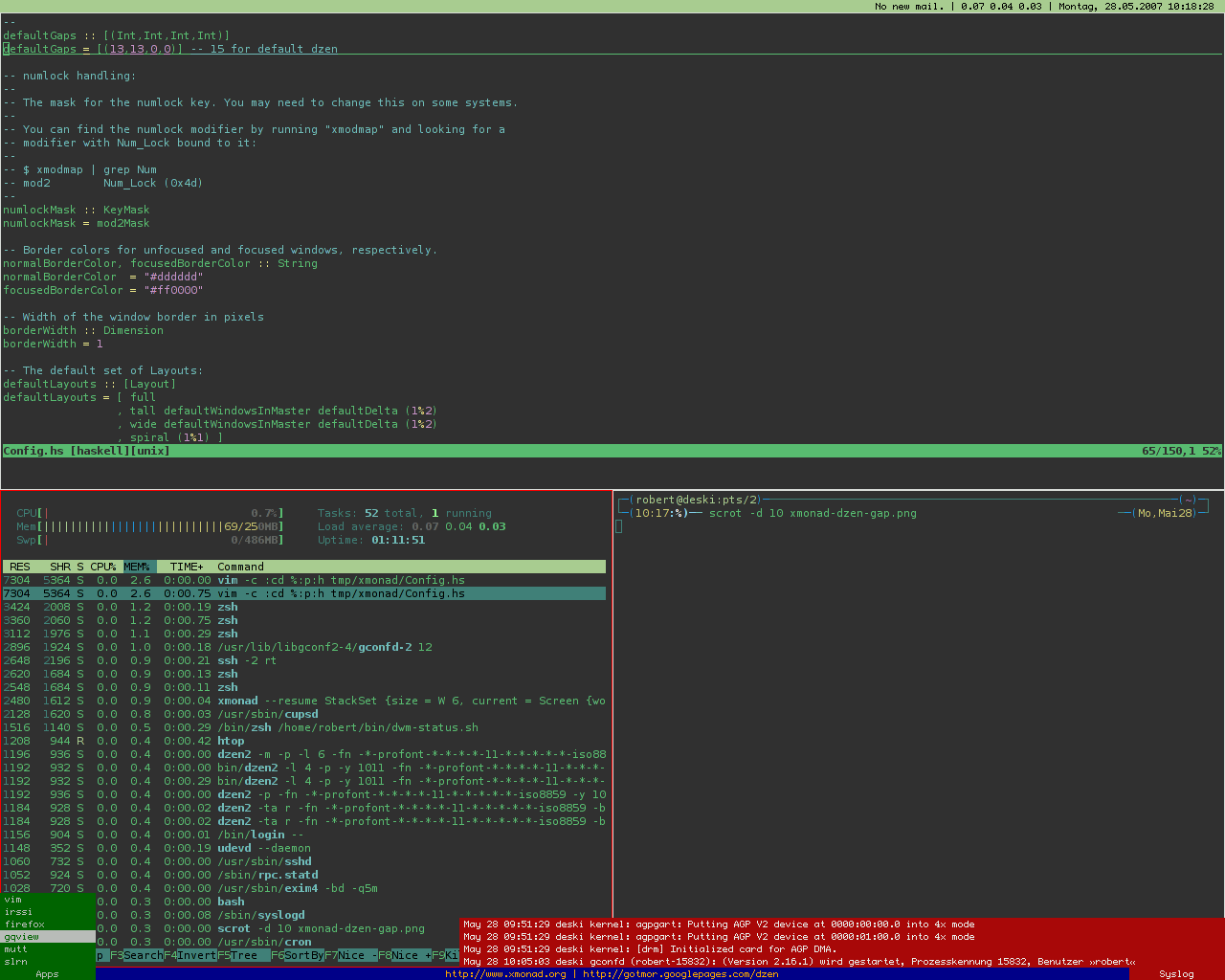
  • xmonad, A tiling window manager

Projects using Haskell (2)

Projects using Haskell (3)

Projects using Haskell (4)

Projects using Haskell (5)

  • Pugs by Audrey Tang

What is Functional Programming?

Programming is Encoding

  • Encoding the solution description into some (formal) system
  • Therefore Functional Programming is encoding the description into (mathematical) function
  • Function is first-class value

Comparing to other Programming Paradigms (1)

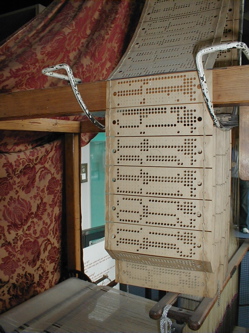
  • Encoding the pattern into the Jacquard Loom

Comparing to other Programming Paradigms (2)

  • Imperative Programming encodes the description into lines of instructions, and its data
    • From Machine instructions to Assembly Language
    • Categorize bit-pattern on a physical machine.
  • Procedural Programming encodes the description into lines of subprograms

Comparing to other Programming Paradigms (3)

Comparing to other Programming Paradigms (4)

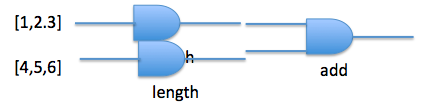
  • Visual Programming
    • A programming language doesn't have to be text-based
    • Encode description into Graph

Theorem Prover

  • Logicism: The theory that mathematics is an extension of logic and therefore some or all mathematics is reducible to logic
  • Encode the description into a propositional logic statement.
  • A logical statement is a theorem
  • Programming is proving a theorem

Human makes Mistakes

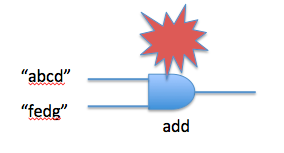
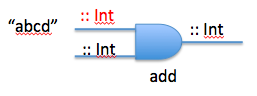
  • We introduces different paradigm of composing, but we human make mistakes when doing composition.
  • If no type, it will cause runtime error, or burn-out circuit boards
  • To prevent ridiculous errors, we check type.

Real World example of Untyped (or single type)

  • Untyped example: Bash
    • put a file named as "-rf"
    • then "rm *"
    • then all of directories and files will be deleted.
  • In Bash, the only type of the language is "String"

Mainstream PL type system defects

  • Tony Hoare said "Null Reference" is his billion-dollar mistake.
  • In java, "Integer" type is actually consists of "integer" and "null"
  • Option Type: "Just 1" or "Nothing".
  • Compiler would complain when pass an option type value to a Integer slot.

More Advanced Type System

  • Type inference (Could be Hindley Milner, System F, or System Fw)

    Prelude> :t (1+1)
    (1+1) :: Num a => a
    Prelude> :t (1+1.0)
    (1+1.0) :: Fractional a => a
  • Algebraic data types (recursively defined types)

    data List a = Nil | Cons a (List a)
  • Parametric Type variale

    data Maybe a = Just a | Nothing

Pure (Function)

  • The function always evaluates the same result value given the same argument value(s). The function result value cannot depend on any hidden information or state that may change as program execution proceeds or between different executions of the program, nor can it depend on any external input from I/O devices.
  • Evaluation of the result does not cause any semantically observable side effect or output, such as mutation of mutable objects or output to I/O devices.

Lazy Evaluation

  • An evaluation strategy which delays the evaluation of an expression until its value is needed (lazy evaluation) and which also avoids repeated evaluations (sharing)

    if a then b else c
  • evaluates (a), then if and only if (a) evaluates to true does it evaluate (b), otherwise it evaluates (c). That is, either (b) or (c) will not be evaluated.

An Overloook of Haskell

Getting started with Haskell

  • Install the Haskell Platform, which includes the GHC(Glasgow Haskell Compiler)
  • Create a file called hello.hs with the following contents:

    main = putStrLn "Hello, world!"
  • Compile your program to a native executable like this:

    $ ghc --make hello
    [1 of 1] Compiling Main             ( hello.hs, hello.o )
    Linking hello ...
    $ ./hello
    Hello, world!

Bindings (1)

  • Haskell uses the = sign to declare bindings:

    x = 2                   -- Two hyphens introduce a comment
    y = 3                   --    ...that continues to end of line.
    main = let z = x + y    -- let introduces local bindings
           in print z       -- program will print 5
  • A binding may declare a function of one or more arguments
    • Function and arguments are separated by spaces (when defining or invoking them)
    add arg1 arg2 = arg1 + arg2   -- defines function add
    five = add 2 3                -- invokes function add
  • Parentheses can wrap compound expressions, must do so for arguments

    bad = print add 2 3     -- error! (print should have only 1 argument)
    main = print (add 2 3)  -- ok, calls print with 1 argument, 5

Bindings (2)

  • Unlike variables in imperative languages, Haskell bindings are
    • immutable - can only bind a symbol once in a give scope
      (We still call bound symbols "variables" though)
    x = 5
    x = 6                      -- error, cannot re-bind x
    • order-independent - order of bindings in source code does not matter
    • lazy - definitions of symbols are evaluated only when needed
    safeDiv x y =
        let q = div x y        -- safe as q never evaluated if y == 0
        in if y == 0 then 0 else q
    main = print (safeDiv 1 0) -- prints 0

Bindings (3)

  • recursive - the bound symbol is in scope within its own definition

    x = 5                 -- this x is not used in main
    
    main = let x = x + 1  -- introduces new x, defined in terms of itself
           in print x     -- program "diverges" (i.e., loops forever)

How to program without mutable variables? (1)

  • In C, we use mutable variables to create loops:

    long factorial (int n)
    {
      long result = 1;
      while (n > 1)
        result *= n--;
      return result;
    }

How to program without mutable variables? (2)

  • In Haskell, can use recursion to "re-bind" argument symbols in new scope

    factorial n = if n > 1
                  then n * factorial (n-1)
                  else 1
    • Recursion often fills a similar need to mutable variables
    • But the above Haskell factorial is inferior to the C one--why?

Tail recursion (1)

  • Each recursive call may require a stack frame
    • This Haskell code requires n stack frames

      factorial n = if n > 1 then n * factorial (n-1) else 1
    • By contrast, our C factorial ran in constant space
  • Fortunately, Haskell supports optimized tail recursion
    • A function is tail recursive if it ends with a call to itself
    • Unfortunately, factorial n multiplies by n after evaluating factorial (n-1)

Tail recursion (2)

  • Idea: use accumulator argument to make calls tail recursive

    factorial n = let loop acc n' = if n' > 1
                                    then loop (acc * n') (n' - 1)
                                    else acc
                  in loop 1 n
    • Here loop is tail recursive, compiles to an actual loop

Every expression and binding has a type (1)

  • Some basic types:
    • Bool - either True or False
    • Char - a unicode code point (i.e., a character)
    • Int - fixed-size integer
    • Integer - an arbitrary-size integer
    • Double - an IEEE double-precision floating-point number
    • type1 -> type2 - a function from type1 to type2
    • (type1, type2, ..., typeN) - a tuple
    • () - a zero-tuple, pronounced unit (kind of like void in C); there only one value of this type, also written ()

Every expression and binding has a type (2)

  • You can declare the type of a symbol or expression with ::

    x :: Integer
    x = (1 :: Integer) + (1 :: Integer) :: Integer
    • :: has lower precedence than any function operators (including +)

More on types (1)

  • Function application happens one argument at a time (a.k.a. "currying")

    add :: Integer -> (Integer -> Integer)
    add arg1 arg2 = arg1 + arg2
    • So add 2 3 is equivalent to (add 2) 3
    • (add 2) takes 3 returns 5, so (add 2) has type Integer -> Integer
    • -> associates to the right, so parens usually omitted in multi-argument function types:
      fn :: argType1 -> argType2 -> ... -> argTypeN -> resultType

More on types (2)

  • Usually the compiler can infer types
    • You can ask GHCI to show you inferred types with :t
    *Main> :t add
    add :: Integer -> Integer -> Integer
    • Good practice to declare types of top-level bindings anyway (compiler warns if missing)

User-defined data types (1)

  • The data keyword declares user-defined data types (like struct in C), E.g.:

    data PointT = PointC Double Double deriving Show
    • This declaration declares a new type, PointT, and constructor, PointC
    • A value of type PointT contains two Doubles
    • deriving Show means you can print the type (helpful in GHCI)
  • Note that data types and constructors must start with capital letters

User-defined data types (2)

  • Types and constructors can use the same name (often do), E.g.:

    data Point = Point Double Double deriving Show
  • One type can have multiple constructors (like a tagged union):

    data Point = Cartesian Double Double
               | Polar Double Double
                 deriving Show
    data Color = Red | Green | Blue | Indigo | Violet deriving Show

Using data types (1)

  • Constructors act like functions producing values of their types

    data Point = Point Double Double deriving Show
    myPoint :: Point
    myPoint = Point 1.0 1.0
    data Color = Red | Green | Blue | Indigo | Violet deriving Show
    myColor :: Color
    myColor = Red

Using data types (2)

  • case statements & function bindings "de-construct" values with patterns

    getX, getMaxCoord :: Point -> Double
    getX point = case point of
                   Point x y -> x
    getMaxCoord (Point x y) | x > y     = x
                            | otherwise = y
    isRed :: Color -> Bool
    isRed Red = True        -- Only matches constructor Red
    isRed c   = False       -- Lower-case c just a variable

Parameterized types (1)

  • Types can have parameters sort of the way functions do
    • Type parameters start with lower-case letters
    • Some examples from the standard Prelude
    data Maybe a = Just a
                 | Nothing
    data Either a b = Left a
                    | Right b

Parameterized types (2)

  • You can see these at work in GHCI:

    Prelude> :t Just True
    Just True :: Maybe Bool
    Prelude> :t Left True
    Left True :: Either Bool b   
  • Notice the type of Left True contains a type variable, b
    • Expression Left True can be of type Either Bool b for any type b
    • This is an example of a feature called parametric polymorphism

More deconstruction tips

  • Special variable "_" can be bound but not used
    • Use it when you don't care about a value:
    isJust :: Maybe a -> Bool      -- note parametric polymorphism
    isJust (Just _) = True
    isJust Nothing  = False
    isRed Red = True
    isRed _   = False              -- we don't need the non-red value
    • Compiler warns if a bound variable not used; _ avoids this

Lists (1)

  • We could define homogeneous lists with the data keyword

    data List a = Cons a (List a) | Nil
    
    oneTwoThree = (Cons 1 (Cons 2 (Cons 3 Nil))) :: List Integer

Lists (2)

  • But Haskell has built-in lists with syntactic sugar
    • Instead of List Integer, the type is written [Integer]
    • Instead of Cons, the constructor is called : and is infix
    • Instead of Nil, the empty list is called []
    oneTwoThree = 1:2:3:[] :: [Integer]
    • But there are even more convenient syntaxes for the same list:
    oneTwoThree' = [1, 2, 3]    -- comma-separated elements within brackets
    oneTwoThree'' = [1..3]      -- define list by a range
  • A String is just a list of Char, so ['a', 'b', 'c'] == "abc"

Some basic list functions in Prelude (1)

head :: [a] -> a
head (x:_) = x
head []    = error "head: empty list"
tail :: [a] -> a             -- all but first element
tail (_:xs) = xs
tail []     = error "tail: empty list"
a ++ b :: [a] -> [a] -> [a]  -- infix operator concatenate lists
[] ++ ys = ys
(x:xs) ++ ys = x : xs ++ ys

Some basic list functions in Prelude (2)

length :: [a] -> Int         -- This code is from language spec
length []    =  0            -- GHC implements differently, why?
length (_:l) =  1 + length l
filter :: (a -> Bool) -> [a] -> [a]
filter pred [] = []
filter pred (x:xs)
  | pred x     = x : filter pred xs
  | otherwise  = filter pred xs

Note function error :: String -> a reports assertion failures

Lambda abstraction

  • Sometimes you want to name the arguments but not the function
  • Haskell allows anonymous functions through lambda abstraction
    • The notation is \variable(s) -> body (where \ is pronounced "lambda")
  • Example:

    countLowercaseAndDigits :: String -> Int
    countLowercaseAndDigits = length . filter (\c -> isLower c || isDigit c)

Hoogle

  • Hoogle is a search engine just for Haskell functions

Try Haskell

Courses

Books

Thank you